
Every artist knows the frustration: staring at a blank canvas, cycling through the same visual ideas, feeling trapped by familiar patterns. Your technical skills are sharp, but something blocks the flow of genuinely original concepts. The problem isn’t talent—it’s mental rigidity.
Research shows that playing specific board games temporarily improves divergent thinking capacity, particularly enhancing originality. The effect is strongest for participants starting with low creative potential, proving these games actively exercise your ideation abilities.
This isn’t about games featuring beautiful artwork. We’re talking about mechanically creative games—ones where the core gameplay forces you to generate, abstract, and communicate novel ideas under constraint. These games create what psychologists call a “magic circle”: a safe, temporary space where you can generate bad ideas without professional consequences, a necessary step toward discovering breakthrough concepts.
The Three Types of Creative Games That Actually Work
Not all “creative” games deliver real benefits. The most effective ones fall into three distinct categories, each targeting different cognitive skills:
Conceptual Association Games break linear thinking patterns and force unusual connections between disparate ideas. These combat the blank-page paralysis.
Spatial Design Games optimize your visual composition skills, color theory application, and geometric problem-solving under strict constraints.
Rapid Prototyping Games train you to communicate ideas quickly through visual shorthand, prioritizing clarity over polish—the hallmark of professional concept art.
The most effective creative sessions cycle through all three types, creating a comprehensive cognitive workout that mirrors real-world creative challenges.
Breaking Mental Blocks: Conceptual Association Games
Dixit: Training Your Brain to Think in Metaphors
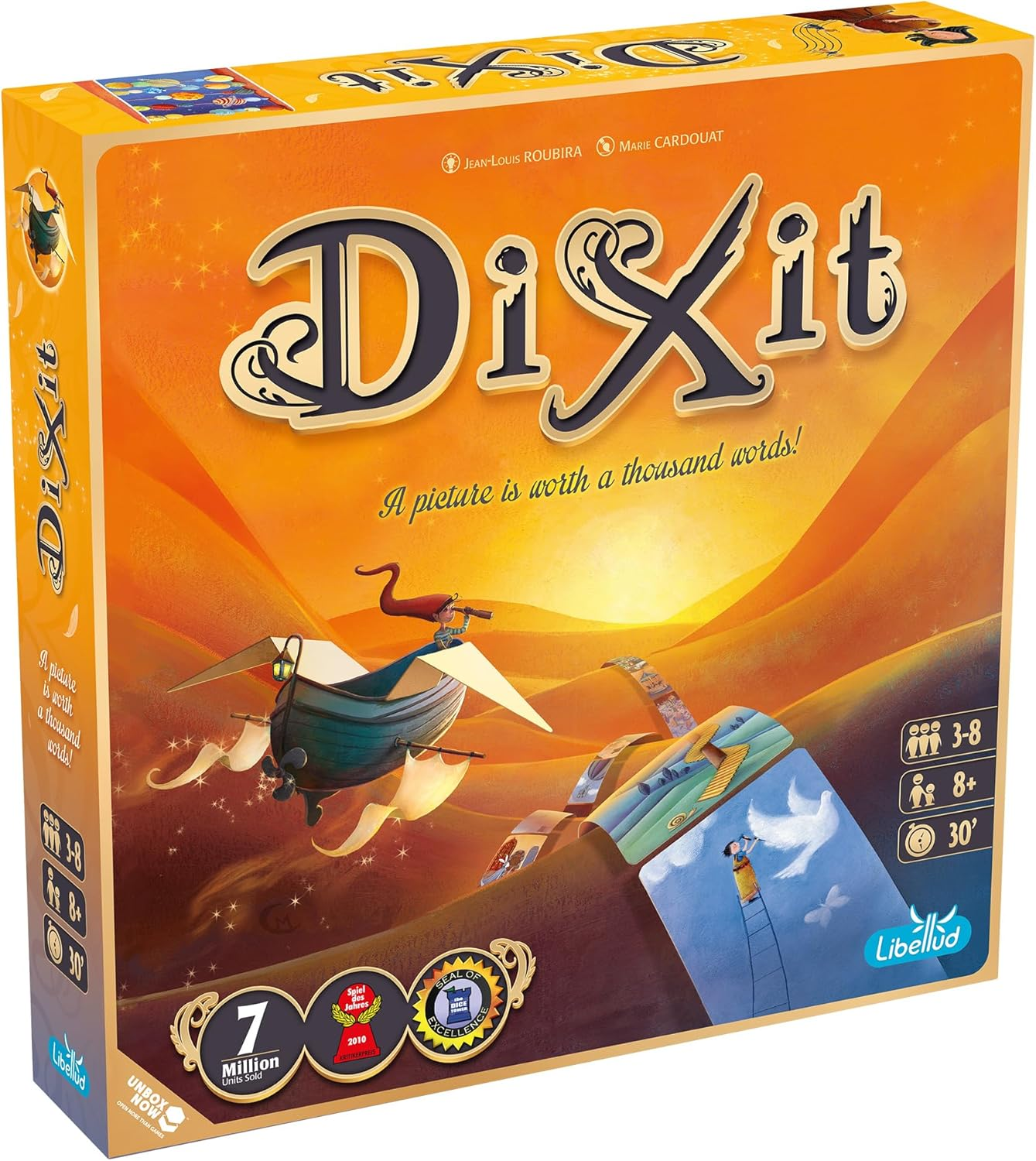
Asmodee Dixit Board Game [click to view…]
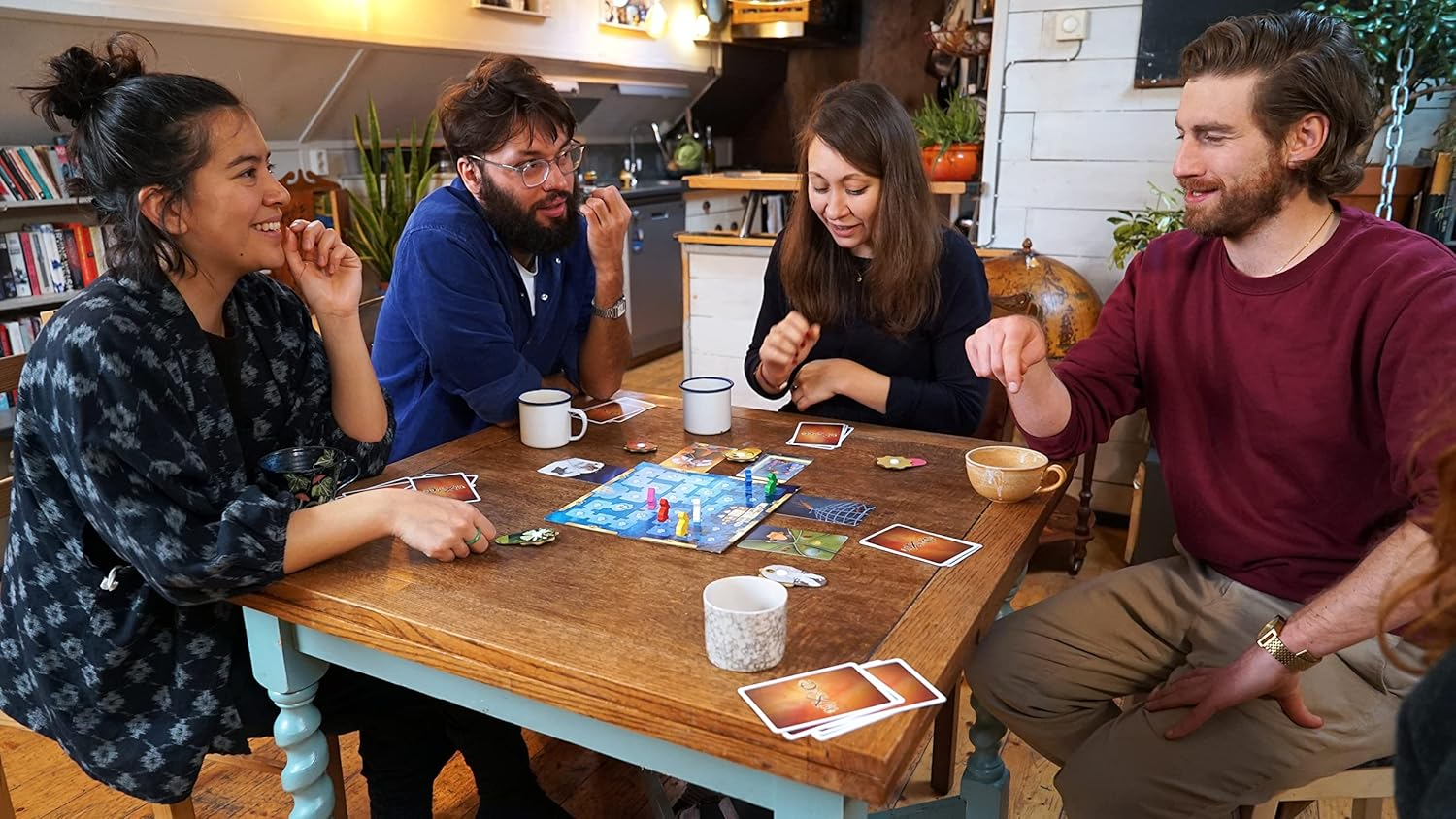
Dixit presents players with 84 abstract, surreal image cards. You select one card and provide a verbal clue—but the trick is crafting something ambiguous. You want some players to guess your card, but not everyone. Too obvious and you score nothing. Too obscure and the same problem occurs.
This mechanical tension forces you to connect concepts through emotional symbolism rather than literal description. You’re training the exact skill needed for high-level illustration: translating abstract project themes into visual language that guides without dictating the final outcome.
The cards themselves feature dreamlike, multi-layered imagery deliberately designed for interpretation rather than recognition. Playing Dixit is practicing the art director’s skill of crafting emotionally resonant visual prompts.
Amazon USA Details:
- Price: $39-45
- Players: 3-8
- Time: 30 minutes
- Best for: Illustrators, concept artists, art directors
Concept: Distilling Complex Ideas into Pure Symbols

Concept Party Game [click to view…]
Concept challenges you to communicate any word or phrase using only a board filled with universal icons—color, shape, size, human traits, animals, and abstract concepts. Place pawns on icons to build your message without speaking.
How do you convey “Justice” or “Renaissance” using only these visual primitives? You must identify the absolute essential components of complex ideas and represent them through pure association.
This exercise is invaluable for UI/UX designers, iconographers, and anyone who needs to translate abstract requirements into concrete visual forms. Professional design is exactly this: converting complex user stories and business needs into functional symbols.
Amazon USA Details:
- Price: $25-40
- Players: 4-12
- Time: 40 minutes
- Best for: Graphic designers, UI/UX professionals, iconographers
Rory’s Story Cubes: Your Portable Idea-Breaking Tool

Rory’s Story Cubes Classic [click to view…]
Roll nine dice, each showing different non-contextual images (54 total possibilities). Now weave a coherent story connecting all nine random visuals that appear.
These cubes excel at forced connections and randomness generation. They prevent predictable narrative paths and character tropes by introducing elements you’d never consciously choose. The randomization activates the SCAMPER brainstorming principle (Substitute, Combine, Adapt) automatically.
Story Cubes work exceptionally well for solo ideation sessions. Stuck on character backgrounds? Roll the dice. The visual prompts provide immediate, concrete starting points that bypass the blank-page problem entirely.
Amazon USA Details:
- Price: $10-15
- Players: 1+
- Time: 10-20 minutes
- Best for: Solo brainstorming, writers, world-builders, character designers
Mastering Visual Composition: Spatial Design Games
Azul: Where Aesthetics Meet Strategy
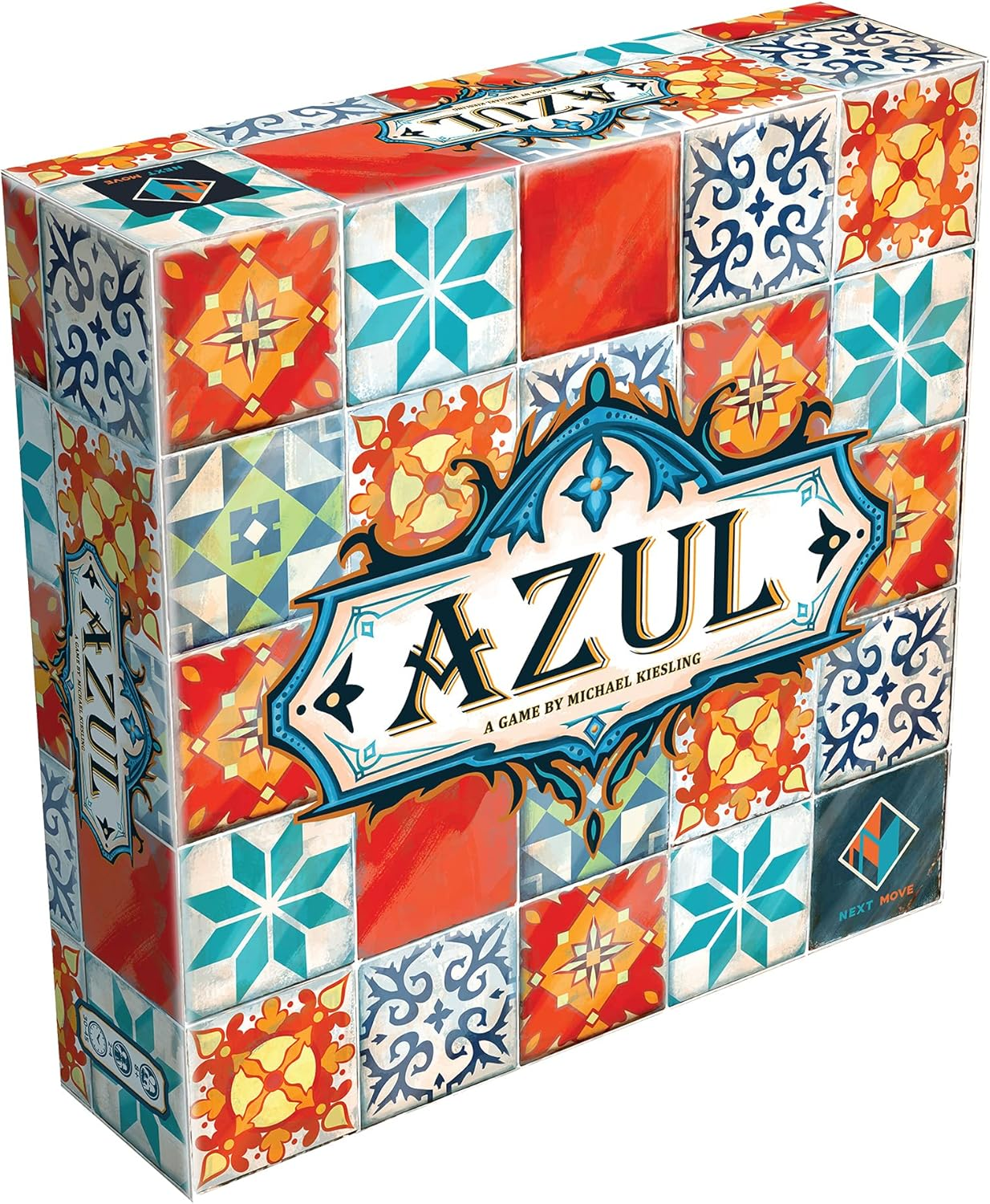
Azul Asmodee Azul Board Game [click to view…]
Azul requires you to draft decorative tiles from a central pool and strategically place them on your board to complete color patterns and sets. Success depends on creating visually harmonious arrangements while managing limited resources.
The game teaches that visual composition is inseparable from optimized resource management. You’re constantly balancing aesthetic goals (completing beautiful wall patterns) with functional performance (maximizing points while minimizing waste).
Multiple editions offer different challenges: Stained Glass of Sintra uses different tile shapes, Queen’s Garden introduces new scoring structures. Each version provides fresh exercises in visual flow and compositional organization across different design mediums.
Amazon USA Details:
- Price: $25-45
- Players: 2-4
- Time: 30-45 minutes
- Best for: Graphic designers, pattern designers, anyone optimizing visual layouts
Calico: Advanced Pattern and Color Theory Training
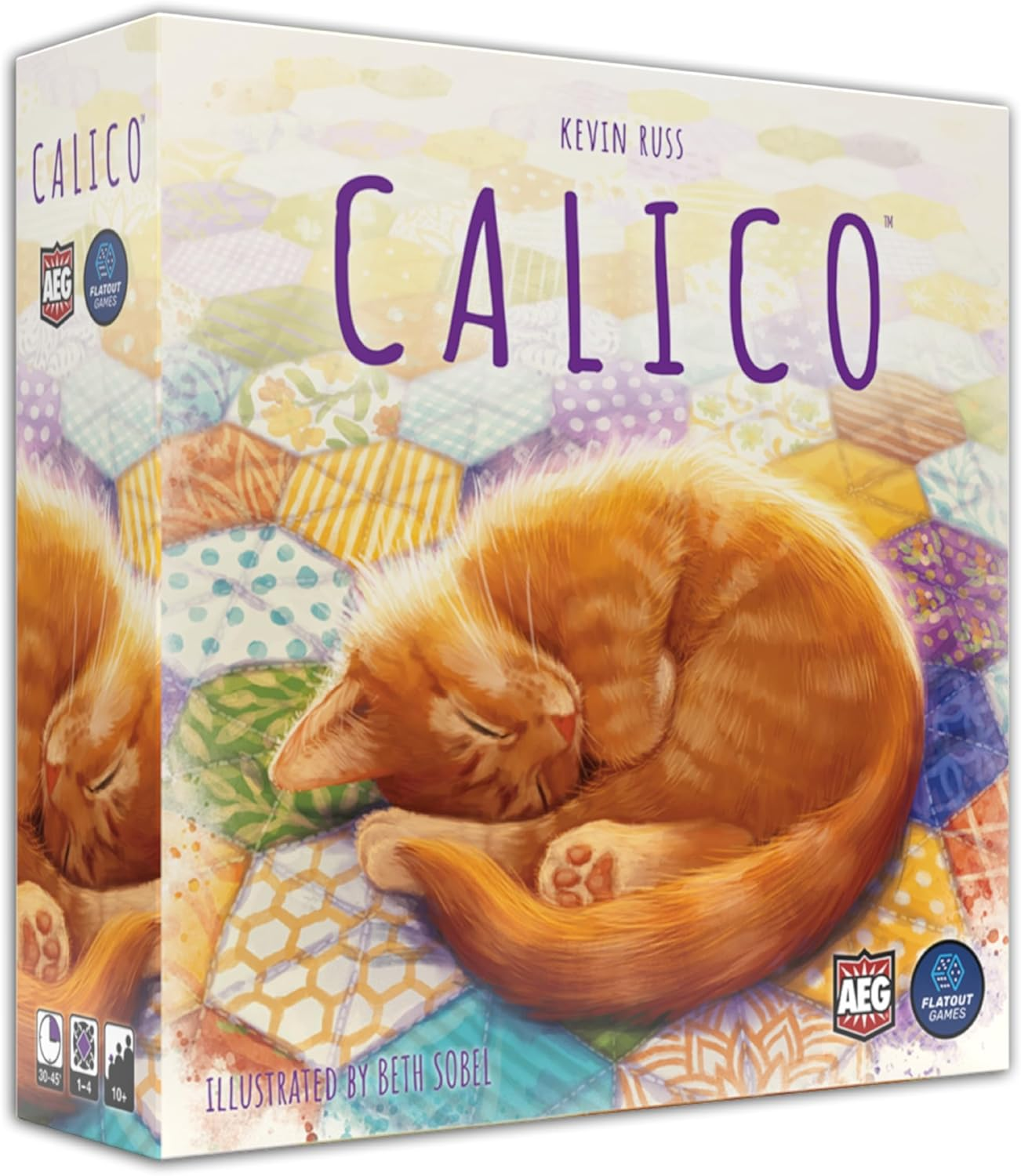
AEG & Flatout Games [click to view…]
Calico involves placing hexagon tiles featuring six different colors and designs to construct a quilt. You score by matching specific pattern objectives, gathering color groups, and attracting cat tokens (which have their own placement requirements).
This game directly incorporates core art principles—color, pattern, and shape—into textile design mechanics. The hexagonal tiles create complex adjacency relationships that train your brain to visualize multi-layered pattern interactions.
The challenge intensifies because you’re simultaneously satisfying multiple scoring conditions: color adjacency, pattern matching, and spatial placement for cat preferences. It’s a sophisticated exercise in balancing competing aesthetic priorities.
Amazon USA Details:
- Price: $35-50
- Players: 1-4
- Time: 30-45 minutes
- Best for: Textile designers, pattern creators, illustrators focused on decorative work
Patchwork: Mastering Negative Space and Geometric Constraints
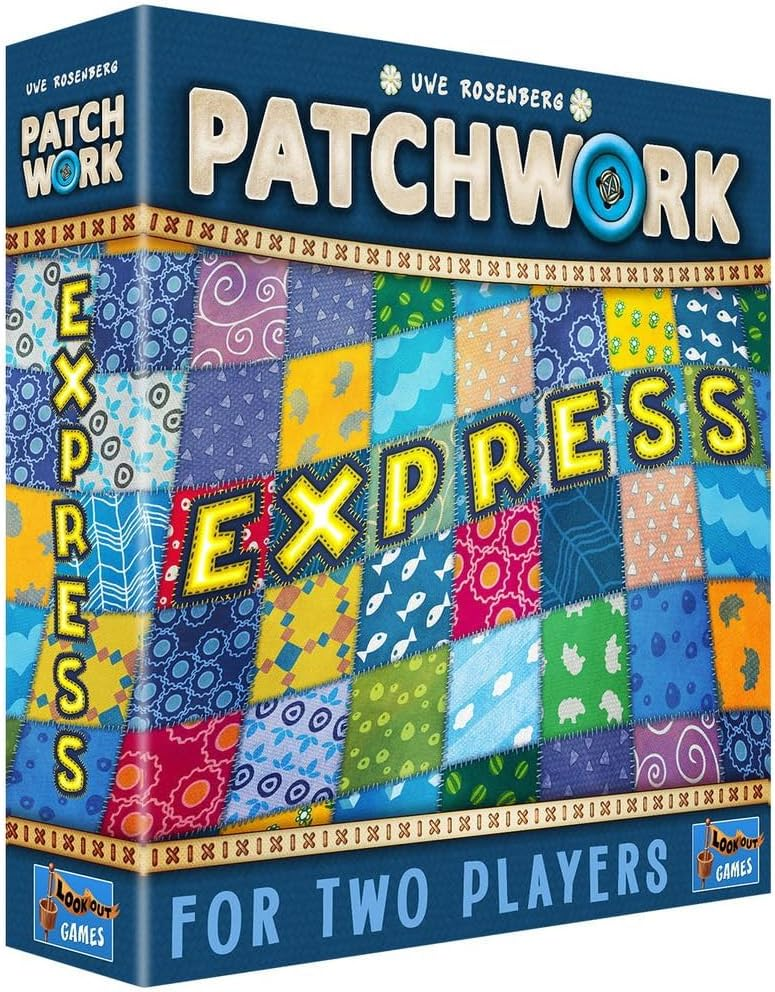
Patchwork Express Board Game [click to view…]
This two-player game is a focused spatial puzzle where you draft irregular “patches” (Tetris-like polyominoes) to efficiently cover your 9×9 quilt board. You manage both time and buttons (currency) as resources.
Patchwork forces you to think about irregular forms and negative space simultaneously. Every piece you select creates new constraints and opportunities. The puzzle directly translates to professional challenges: fitting complex visual elements into predefined website grids, product packaging templates, or dense illustrations where space is premium.
The polyomino shapes train your brain to visualize and manipulate non-rectangular spatial interactions—a foundational skill for environment designers and visual artists working with complex compositions.
Amazon USA Details:
- Price: $25-35
- Players: 2
- Time: 15-30 minutes
- Best for: Layout designers, environment artists, anyone working with spatial constraints
Speed and Communication: Rapid Prototyping Games
Telestrations: Training Visual Shorthand Under Pressure
Telestrations combines the telephone game with Pictionary. Players alternate between drawing a word or phrase and guessing what the previous player drew. A one-minute sand timer and thick dry-erase markers force efficiency.
The time constraint is the key teaching mechanism. It compels you toward visual shorthand, prioritizing the communication of functional information over polished execution. This skill is central to concept art, which requires high-speed iteration and sketches that convey ideas, not finished illustrations.
The humorous miscommunications provide immediate, unfiltered feedback on how clearly your visual translation reads to others. Highly skilled artists often instinctively draw too well, which slows the process and limits idea divergence. The timer forces you back to rapid exploration mode.
Amazon USA Details:
- Price: $30-55 (depending on player count)
- Players: 4-12
- Time: 30 minutes
- Best for: Concept artists, animators, art directors, anyone needing rapid visualization skills
MicroMacro Crime City: Forensic Attention to Detail
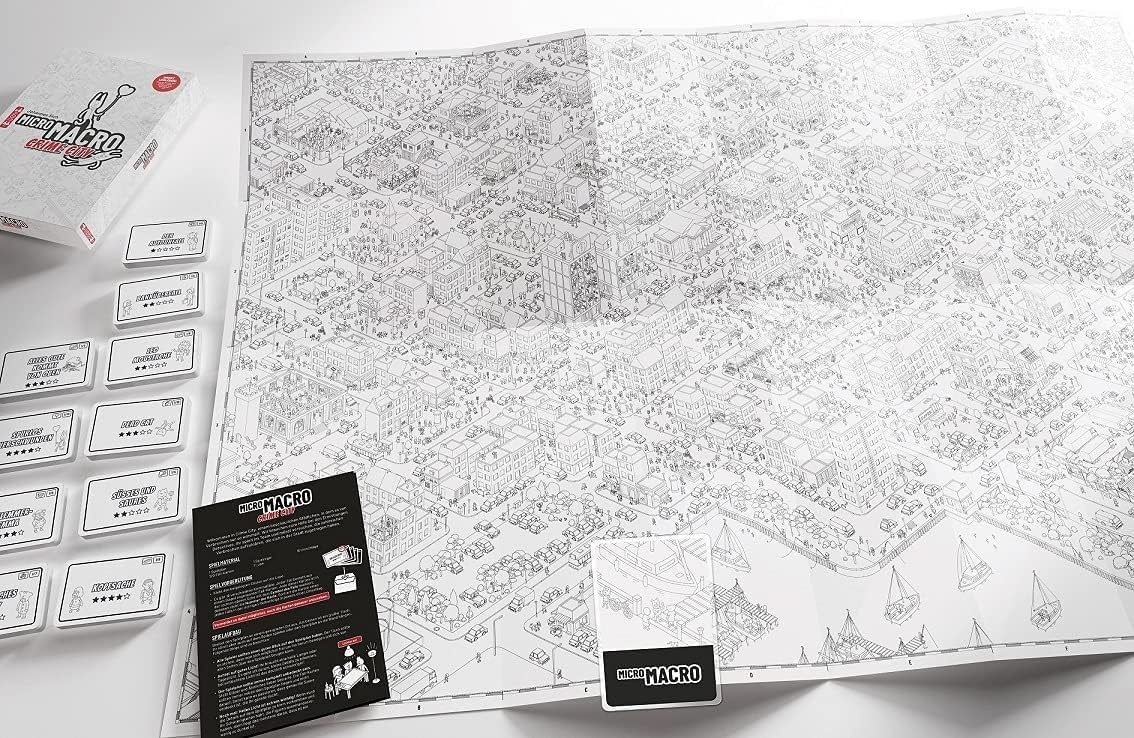
MicroMacro: Crime City – Board Game [click to view…]
This cooperative detection game centers on a giant, densely detailed map illustration. Players solve complex cases by tracking characters and finding tiny visual details across the panoramic landscape.
MicroMacro functions as “illustration as forensic puzzle.” It demands acute attention to visual narrative continuity and layered detail construction. For environment artists and illustrators creating densely detailed worlds, the necessity of scrutinizing art for narrative consistency provides critical training.
The game demonstrates that illustration itself can be the puzzle, teaching you to imbue work with multiple layers of discoverable information that rewards close inspection.
Amazon USA Details:
- Price: $20-35
- Players: 1-4
- Time: 15-45 minutes per case
- Best for: Environment artists, illustrators focused on world-building, detail-oriented creators
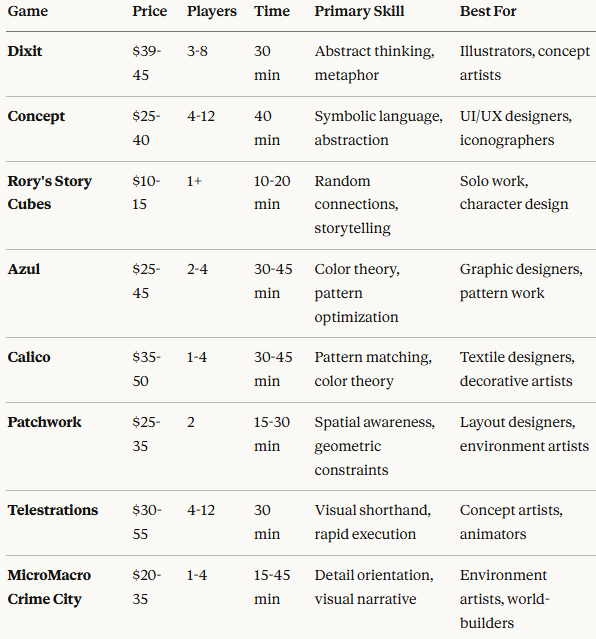
Complete Game Comparison: Finding Your Perfect Creative Tools
How to Structure Your Creative Game Night for Maximum Impact
Transform casual game night into a structured professional development workshop using this three-phase approach:
Phase 1: Divergence (20-30 minutes)
Start with conceptual games like Dixit or Rory’s Story Cubes. The goal is generating high volume, zero judgment. Before playing, define a tangible project challenge. If you’re stuck on “fantastical ecosystem concepts,” focus your Dixit clues on biology or mythology themes.
Generate as many ideas as possible. Write them down. Quality doesn’t matter yet.
Phase 2: Focus and Refinement (30-60 minutes)
Transition to spatial games like Azul or Patchwork. These ground your thinking in visual constraint and optimization principles. While playing, mentally apply the aesthetic principles you’re exercising to the raw concepts from Phase 1.
Ask yourself: “How does this color constraint in Azul relate to my project’s limited palette? Can I apply this spatial efficiency to my concept layouts?”
Phase 3: Communication and Feedback (20-30 minutes)
Conclude with rapid communication games like Telestrations. This simulates presenting low-fidelity ideas to a team for quick feedback. Test whether your refined concepts communicate clearly under time pressure.
The goal: can someone else understand your idea from a 60-second sketch?
The Critical Post-Game Debrief
Dedicate 15-20 minutes immediately after playing to connect game actions to professional insights. The “magic circle” only transfers learning to real work through deliberate reflection.
Questions to ask:
- “Where did I struggle most with constraint? How does that mirror my current project challenge?”
- “Which random combination yielded the most unusual concept? Can I force that non-linear thinking into my next iteration?”
- “When did my sketches communicate clearly versus when did they confuse? What specific shorthand worked?”
Solo Adaptation: Using Game Mechanics for Individual Work
You don’t need a group to benefit from these tools. Adapt the mechanics for solo ideation sessions:
The Creativity Dice Method: Use Rory’s Story Cubes as a physical alternative to digital prompt generators. The tactile act of rolling and arranging dice interrupts established thought patterns more effectively than scrolling through suggestions.
The Constraint Grid Exercise: Replicate Azul or Patchwork’s spatial constraints by imposing a grid structure on your work. Create a simple 5×5 layout, then organize random visual assets (from reference folders or stock imagery) within that constraint. This mechanically exercises compositional skills developed during physical gameplay.
Reverse Pictionary for Self-Direction: Record yourself verbally describing a concept without naming it directly. Play it back the next day and sketch based only on that description. This trains the communication loop between verbal brief and visual execution.
Buying Recommendations by Artist Type
For Concept Artists and Art Directors
Priority: Speed and clear communication
- Telestrations ($30-55) – Essential for rapid execution training
- Concept ($25-40) – Master semantic abstraction
- Rory’s Story Cubes ($10-15) – Budget-friendly prompt generation
Why these work: Concept art prioritizes functional blueprints over finished illustrations. These games train high-speed iteration and visual problem-solving.
For Illustrators and Fine Artists
Priority: Aesthetic depth and metaphorical thinking
- Dixit ($39-45) – Develop surreal, metaphorical visual language
- MicroMacro Crime City ($20-35) – Master layered detail and narrative
- Azul ($25-45) – Refine compositional optimization
Why these work: Illustration demands meticulous visual planning and the ability to embed multiple layers of meaning in finished work.
Budget-Conscious Starter Kit
Total investment: Under $50
- Rory’s Story Cubes ($10-15) – Solo-friendly ideation tool
- Patchwork ($25-35) – Sophisticated spatial training for two players
This combination covers conceptual association (Story Cubes) and spatial design (Patchwork) without breaking the bank.
Premium Professional Development Set
Total investment: $150-200
- Dixit ($39-45)
- Telestrations ($30-55)
- Azul ($25-45)
- Concept ($25-40)
- Calico ($35-50)
This collection covers all three categories comprehensively, supporting groups of varying sizes and addressing every major creative skill area.
Turning Play into Professional Breakthrough
The creative professionals who consistently produce original work aren’t just naturally gifted—they’ve developed systems for breaking mental rigidity. Structured play through mechanically creative board games provides one of the most efficient methods for training divergent thinking.
The difference between casual entertainment and professional development lies in intentionality. When you approach game night as a structured workshop—defining challenges beforehand, cycling through conceptual, spatial, and communication exercises, and conducting post-game reflection—you transform play into genuine skill development.
True innovation rarely comes from working harder within existing constraints. It comes from purposefully stepping into the low-stakes freedom of structured play to unlock ideas that would otherwise remain inaccessible.
Start with one game. Dedicate one evening per week. Track which mechanisms produce the most useful breakthroughs for your specific work. Within a month, you’ll notice shifts in how quickly you generate original concepts and how effectively you communicate visual ideas.
The creative block you’re facing isn’t permanent—it’s a pattern. And patterns can be disrupted through deliberate practice disguised as play.
Other Popular Posts:
 Best Wearable Exoskeleton For Walking: Thousands Now Walk Again Who Never Thought They Could & See How This Technology Gave Them Their Lives Back
 Self-Moving Chess Board Automates Your Games Against A.I. Engines Or Players Around The World
 Art and Writing Prompt Cards: The Little-Known Daily Ritual That Transforms Hesitant Creators Into Prolific Artists
 You Thought 3D Imaging Was Modern Technology? These Vintage Photos From 1850s Japan Prove You Wrong
 10 Clever Artists Who Let Nature Do The Hard Work For Them (With Incredible Results)
 10 Most Beautiful Google Earth Aerial Landscapes You Never Saw Before
 10 CREATIVE Bathroom Toilet Games That Will Help You Relax During Constipation
 10 BEST Cutting Board Designs That Will Wow Your Guests Like Crazy
 Whiteboard Sticker Paper Turns Any Surface Into A Magnetic White Board You Can Draw On