
Here’s what separates people who thrive from those who stagnate: their relationship with failure.
Most people define success as the absence of mistakes. That’s backwards.
Real success is mastery of recovery. It’s the ability to fall, learn precisely what went wrong, and rise stronger than before.
The problem? Without a clear framework for processing setbacks, you’ll default to shame, avoidance, and a fixed mindset that treats every mistake as proof of your inadequacy. This mental trap guarantees one outcome: you stop taking the risks necessary for growth.
The six books outlined here form a complete system—tested across psychology, philosophy, neuroscience, and business—for transforming failure from a source of shame into your greatest teacher.
This isn’t motivational fluff. This is the curriculum top performers and leaders use when stakes are highest.
Why This Matters Right Now
The real cost of delayed learning: Every month you operate without these frameworks, you’re making the same mistakes twice. You’re experiencing preventable shame. You’re avoiding challenges that would catapult your career or business forward.
Failure avoidance doesn’t prevent failure—it guarantees stagnation.
The individuals who skip this work typically follow a predictable path:
- They encounter a setback and internalize it as a personal flaw
- They feel deep shame and pull back from risk
- They blame external circumstances instead of analyzing process
- They repeat the same error because they never extracted the lesson
- Their potential remains trapped behind a wall of fear
The alternative? A structured, evidence-based system for converting every setback into actionable intelligence.

The Four-Phase System: Your Failure Mastery Framework
Effective resilience operates across four interdependent disciplines:
Phase 1: Cognitive Resilience (Perception) The mental framework used to interpret events. Can you view your setback as information, or do you see it as proof of your limitations?
Phase 2: Philosophical Resilience (Will) The internal strength required to endure difficulty. How do you maintain composure and virtue when circumstances are unfair or catastrophic?
Phase 3: Emotional Resilience (Processing) The ability to sit with uncomfortable emotions without suppressing them. Can you process shame and vulnerability instead of running from them?
Phase 4: Systemic Resilience (Action) The practical methodology to convert mistakes into data. Do you extract precise lessons from each failure, or do you repeat patterns?
Each phase requires its own toolkit. Let’s examine which books provide that toolkit.
The Six Essential Books: Your Complete Curriculum
Phase 1: Cognitive Reframing
1. Mindset: The New Psychology of Success by Carol Dweck
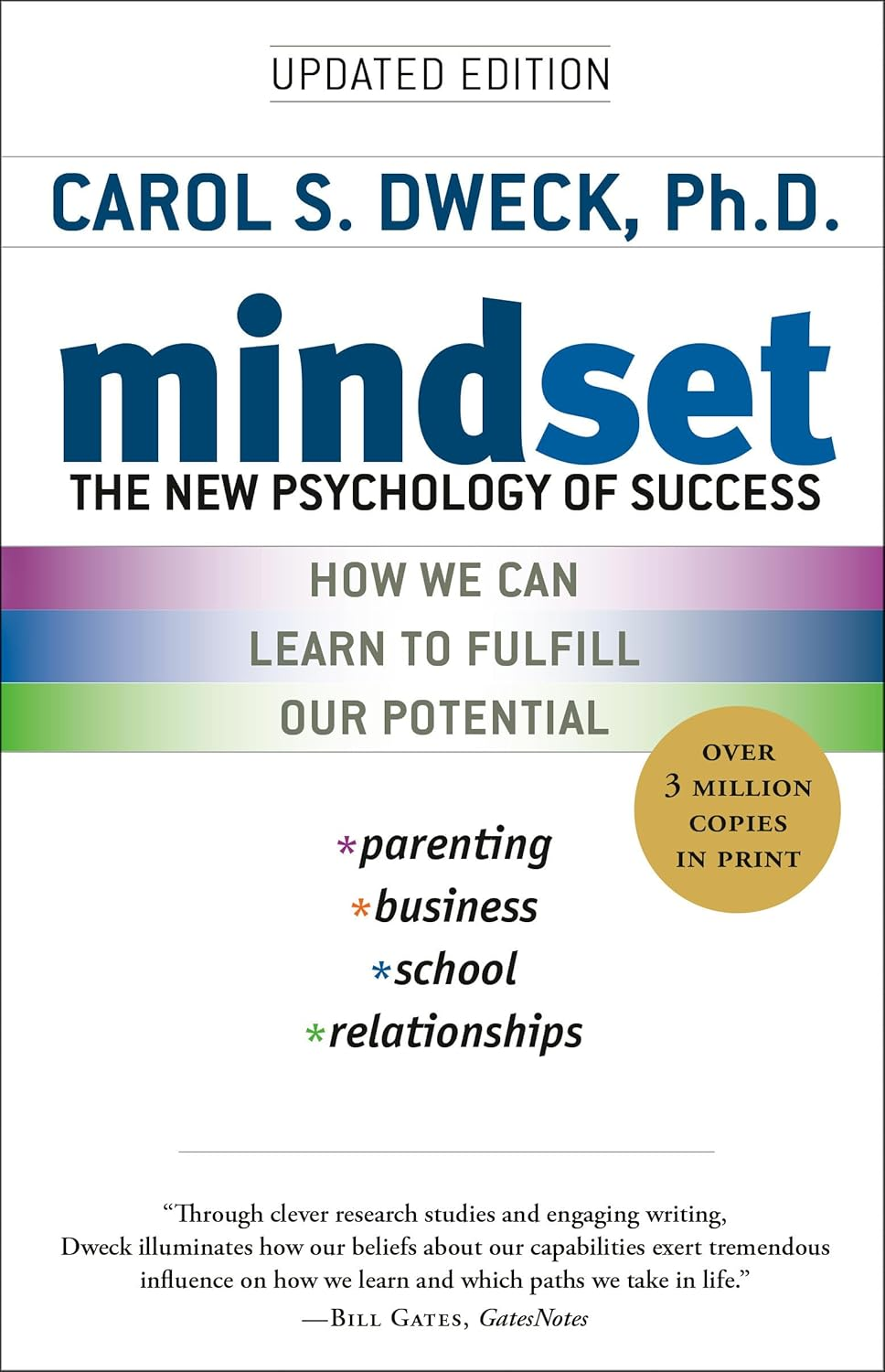
Mindset: The New Psychology of Success [click to view…]
What it addresses: The foundational belief system that determines whether you grow from failure or retreat from it.
The core insight: Your abilities are not fixed. Intelligence, talent, and capability are developed through effort, not born with you.
Dweck’s research reveals a startling pattern: “bright” individuals often quit faster when facing complex challenges. Why? Because they’ve been conditioned to protect the identity of being smart. Struggling feels like proof they’re not talented, so they abandon the task to preserve their self-image.
This is the fixed mindset trap. And it’s devastating.
The growth mindset, by contrast, views failure as feedback. Your result didn’t meet the goal? That’s information. Time to adjust strategy and try again.
Why read it first: Without this cognitive shift, every other framework in this list will feel like empty motivation. Dweck gives you permission to fail, which is the prerequisite for everything that follows.
2. Grit: The Power of Passion and Perseverance by Angela Duckworth
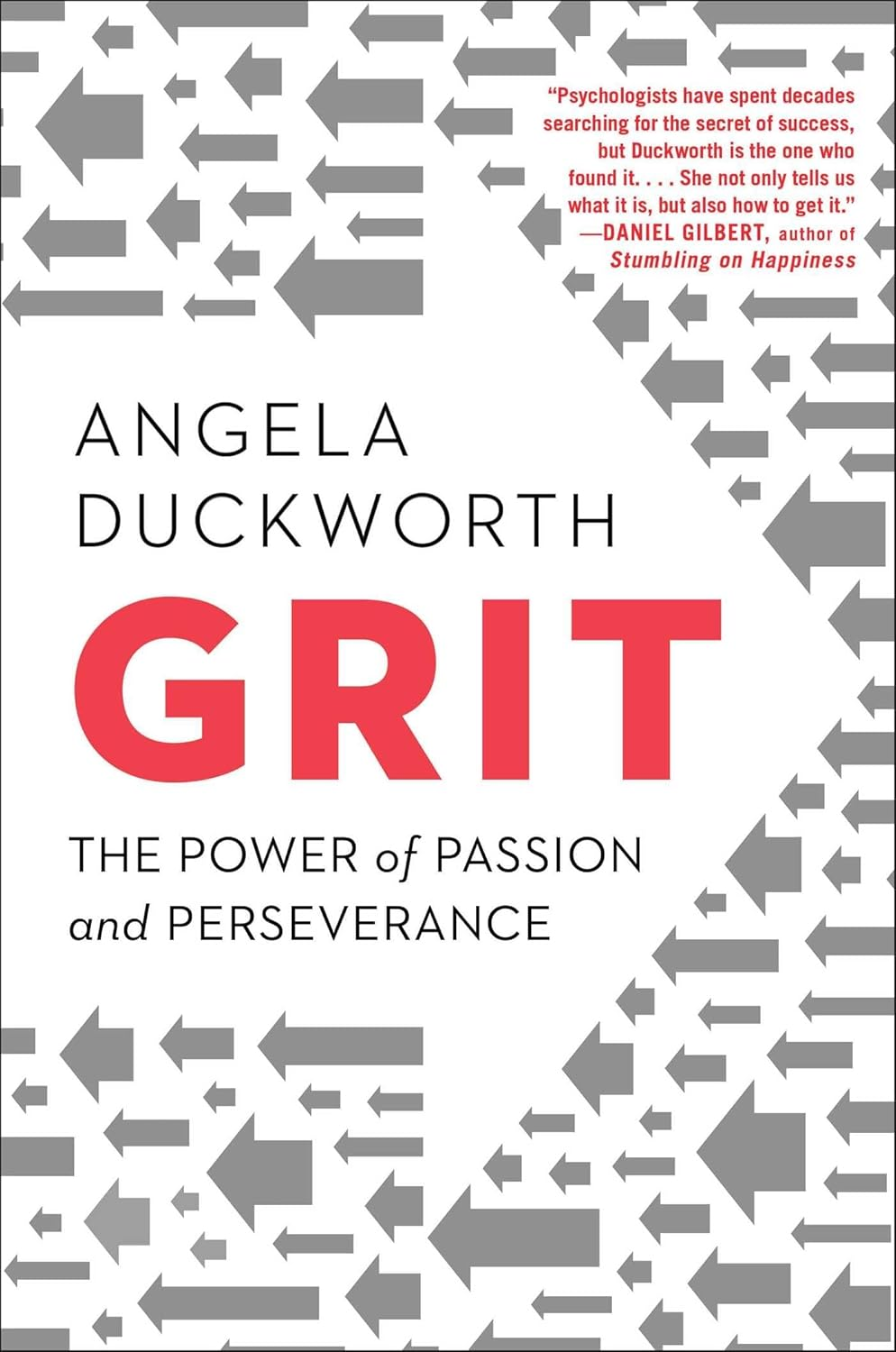
Grit: The Power of Passion and Perseverance [click to view…]
What it addresses: The behavioral execution required for decades-long achievement. Talent alone doesn’t explain success. Effort does.
The core insight: Sustained success requires four elements:
- Interest (passion that’s cultivated, not discovered)
- Practice (deliberate, daily effort to improve)
- Purpose (conviction that your work matters)
- Hope (rising-to-the-occasion perseverance through disappointment)
Duckworth’s research across West Point cadets, spelling bee champions, and corporate employees reveals a consistent pattern: those who sustain effort on meaningful long-term goals outperform those with raw talent.
The practical mechanism: gritty individuals align their daily tasks toward a singular top-level purpose. Each small failure becomes data about how to improve that day’s effort, not a verdict on their capability.
Why it matters: Mindset gives you permission to fail. Grit shows you how to persist productively through repeated small failures until breakthrough occurs.
Phase 2: Philosophical Grounding
3. The Obstacle Is the Way by Ryan Holiday
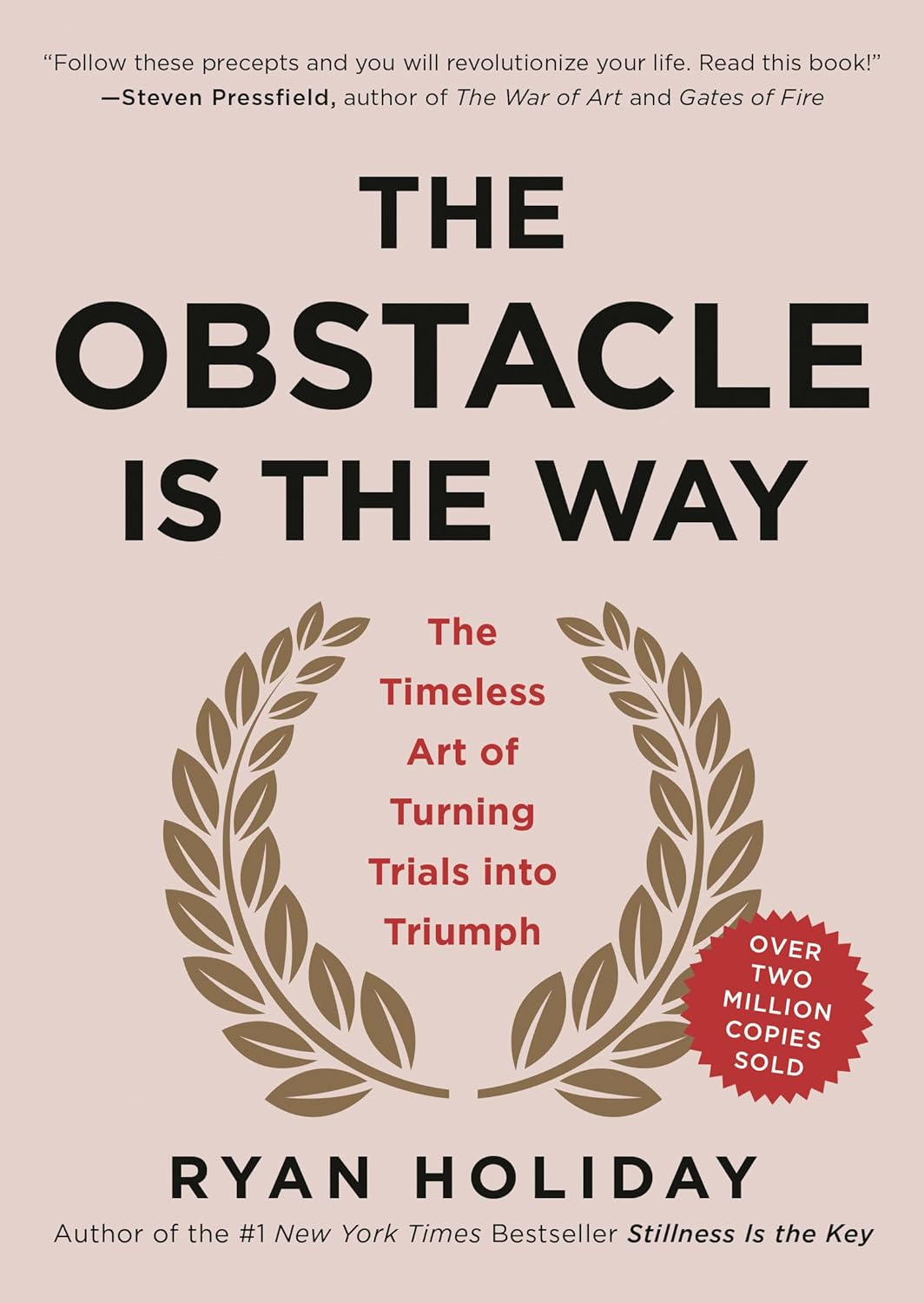
The Obstacle Is the Way [click to view…]
What it addresses: Immediate operational strength when facing massive external obstacles or setbacks outside your control.
The core insight: The impediment becomes the path forward. Obstacles are opportunities to practice virtue and advance.
Holiday applies ancient Stoic principles (Marcus Aurelius, Epictetus, Seneca) to modern challenges through three disciplines:

This is not positive thinking. This is clarity-based reframing that reduces emotional charge and opens lines of action.
Why read it when: Use this when facing a challenge that feels overwhelming or partly outside your control. It provides immediate psychological stabilization.
4. Man’s Search for Meaning by Viktor Frankl

Man’s Search for Meaning [click to view…]
What it addresses: Finding purpose during profound loss, trauma, or existential crisis. Surviving the unsurvivable.
The core insight: Life is primarily a quest for meaning. Suffering is unavoidable, but meaninglessness is optional. The “last human freedom” is your choice of attitude in any circumstance.
Frankl, a Holocaust survivor, observed that prisoners who survived the camps typically maintained a powerful overriding purpose—a book to write, a person to reunite with, work left unfinished.
Those who lost purpose often lost will to live.
The transformative principle: “Everything can be taken from a man but one thing: the last of the human freedoms—to choose one’s attitude in any given set of circumstances, to choose one’s own way.”
This reframes the fundamental locus of control. External events may be dictated by circumstance. Your response remains entirely yours.
Why it’s critical: When life circumstances are genuinely catastrophic, cognitive reframing alone won’t suffice. You need existential grounding. Frankl provides it.
Availability: Amazon USA (compact edition, full edition, Kindle)
Phase 3: Emotional Processing
5. Rising Strong by Brené Brown

Rising Strong [click to view…]
What it addresses: The immediate emotional aftermath of failure. Processing shame instead of suppressing it.
The core insight: Resilience requires three steps:
- The Reckoning: Acknowledge the physical and emotional discomfort without running from it. Sit with it.
- The Rumble: Challenge the stories you tell yourself (“I’m incompetent,” “I deserved this”). Examine facts. Move toward self-forgiveness.
- The Revolution: Integrate learnings into your character and behavior. This changes how you lead, live, and relate.
Brown’s research reveals that the fear of shame drives fixed mindset. If you can process shame during the Rumble, you remove the emotional barrier that keeps people stuck.
Asking for help after setback is not weakness. It’s the brave choice.
Why this is essential: Cognitive frameworks and philosophical anchors provide scaffolding. But unprocessed shame will sabotage everything. You need this step.
Phase 4: Systemic Learning
6. Black Box Thinking by Matthew Syed
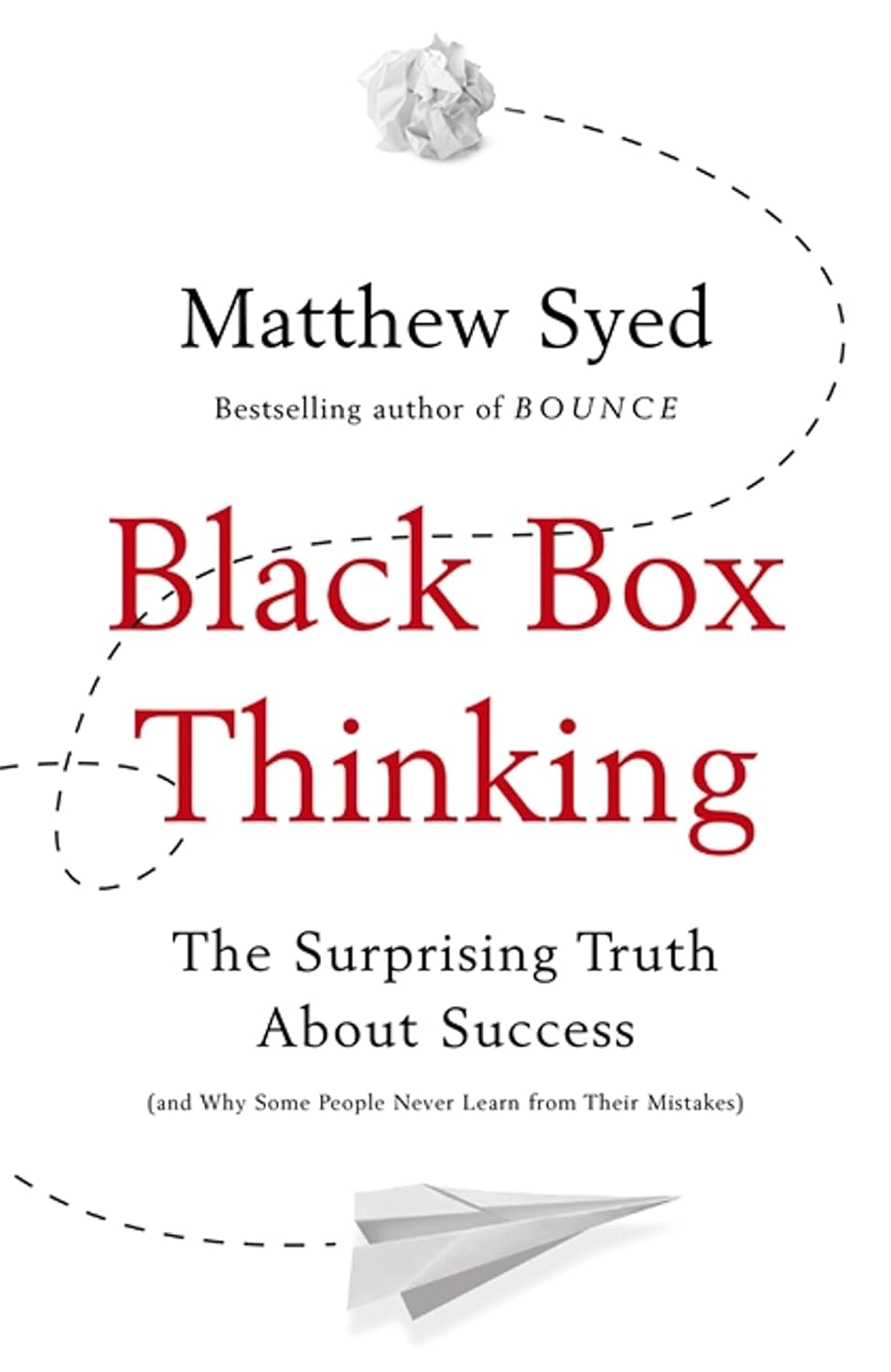
Black Box Thinking [click to view…]
What it addresses: Converting mistakes into high-value data for systematic improvement. Building learning cultures.
The core insight: Aviation has one of the lowest accident rates in history—not through perfection, but through ruthless analysis. After every accident, the flight recorder (black box) is examined in a non-blame culture to extract lessons.
Healthcare, by contrast, suffers from repeated errors because litigation fears suppress error reporting. Shame and cognitive dissonance prevent learning.
The “black box paradigm” transforms failure from personal burden into institutional asset.
Practical tools from the book:
- Marginal Gains: Break long-term goals into small measurable efforts. Maximize learning from rapid, small failures.
- Pre-Mortem Analysis: Before launching a project, identify likely failure points. Distinguish preventable errors from intelligent failures.
Why it matters: Without this final phase, you process one failure well but repeat patterns across multiple contexts. Black Box Thinking ensures every mistake drives iterative improvement.
Which Book Should You Read First?
Your entry point depends on your immediate barrier to resilience:
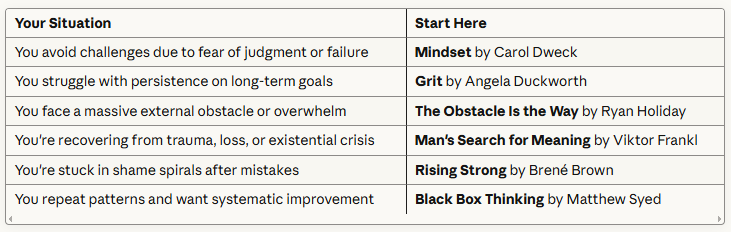
Best overall starting point if unsure: Start with Mindset. It’s the cognitive foundation that enables everything else.
Your 5-Step Failure Playbook: Immediate Implementation
When a significant setback occurs, deploy this protocol:
Step 1: The Pre-Mortem (Preparation) Before launching any critical project, prospectively identify likely failure points. Categorize them:
- Basic Failures (preventable, avoidable mistakes)
- Intelligent Failures (calculated risks in new territory that generate valuable data)
Step 2: The Reckoning (Emotional) Immediately acknowledge and label the difficult emotional state—shame, disappointment, anxiety. Don’t suppress it. Name it.
Step 3: The Stoic Reframing (Philosophical) Shift focus inward to what you control. Recognize: the outcome cannot change, but your attitude remains your choice. Identify which virtue—patience, diligence, honesty—this setback offers an opportunity to practice.
Step 4: Black Box Analysis (Data Review) Separate self from mistake. Analyze what went wrong in the process, not who is flawed. Was this intelligent failure or basic mistake? What precise adjustment does the data suggest?
Step 5: Directed Practice (Execution) Based on analysis, adjust low-level goals and apply deliberate, focused effort toward your top-level purpose. Treat the failure analysis as precise instruction.
Final Word: The Cost of Waiting
The phrase “Don’t Discover These Too Late” carries real weight.
Every month you operate without these frameworks, you’re cycling through preventable shame. You’re making the same mistakes repeatedly. You’re leaving potential on the table.
The individuals who master failure early gain a compounding advantage: each setback becomes fuel for the next iteration, not a reason to quit.
Start with one book this week. Apply one framework this month. Your future self—the one who’s built something meaningful—will thank you for it.
Available now on Amazon USA in all formats. Start today.
Sources: Research compiled from Carol Dweck’s Mindset, Angela Duckworth’s Grit, Ryan Holiday’s The Obstacle Is the Way, Viktor Frankl’s Man’s Search for Meaning, Brené Brown’s Rising Strong, and Matthew Syed’s Black Box Thinking.
Other Popular Posts:
 10 Awesome Coloring Books For Adults To Relieve Stress Like Nothing Else
 18 Fruits & Vegetables That Wanted To Become Something Else… And Did – This Will Inspire You!
 This Sunflower Chair With Smart Integrated Bookcase Turns Reading Into A Whole New Adventure
 10 Worst Funny Knockoff Products That Will Make You Laugh Right Now
 10 UNIQUE & Creative Marriage Proposals That Stunned The World Forever
 225 Sunflower Wedding Ideas That Almost Made Me Cry
 290 Spring Home Decor Ideas That’ll Probably Make Your Home More Beautiful Than Ever Before
 10 Best Shark Tank Products People Are Actually Swearing By (Available on Amazon)
 Art and Writing Prompt Cards: The Little-Known Daily Ritual That Transforms Hesitant Creators Into Prolific Artists